
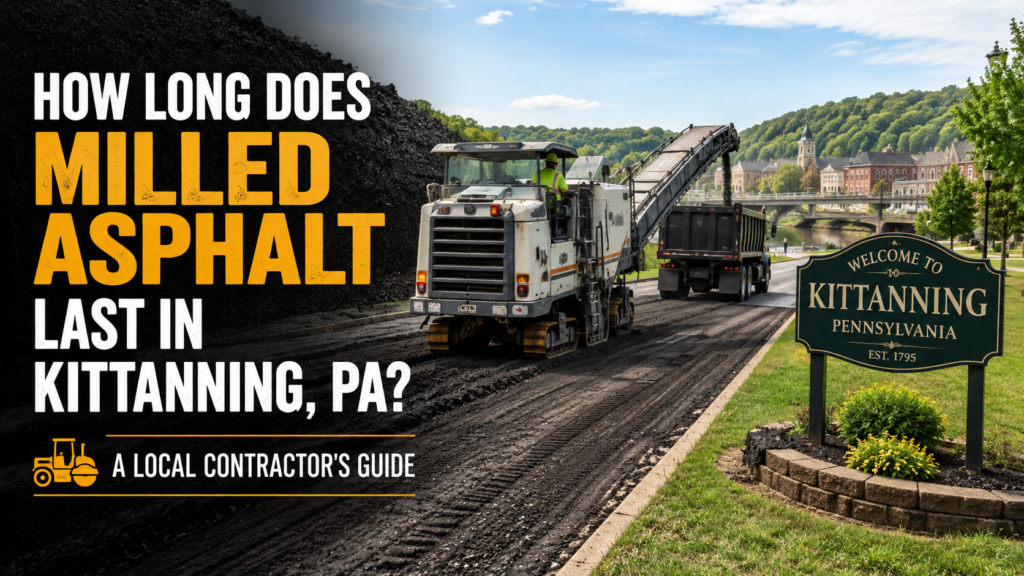
Kittanning is the county seat of Armstrong County, Pennsylvania, situated along the Allegheny River in Western Pennsylvania’s hill country. A community with deep roots in the region’s coal and natural gas industry and a landscape characterized by river valleys and rolling forested hillsides, Kittanning faces the same pavement challenges as any Western Pennsylvania community and some that are unique to its specific geology, terrain, and climate. Among the most common questions Local Asphalt Contractor Kittanning property owners and road managers ask is what role milled asphalt also called reclaimed asphalt pavement, or RAP plays in local road and driveway construction, and how long it lasts in Armstrong County’s demanding environment.
What Is Milled Asphalt?
Milled asphalt properly referred to as reclaimed asphalt pavement (RAP) is asphalt material that has been removed from an existing road or parking lot surface using a cold planer or milling machine. This machine uses a rotating drum studded with carbide cutting teeth to grind the existing asphalt surface to a specified depth, producing a granular material that is conveyed directly into haul trucks as it is cut. The resulting material irregular fragments of asphalt concrete ranging from dust-fine particles up to approximately one-inch pieces is what is commonly called milled asphalt or recycled asphalt.
This material is one of the most recycled materials in the United States. According to the Federal Highway Administration, the asphalt paving industry recycles more material by weight than any other industry in the country over 100 million tons of RAP annually. This recycling serves two purposes: it reduces the demand for virgin aggregate and new asphalt binder in road construction, and it provides a useful material that can be repurposed in various paving and base applications.
Common Uses for Milled Asphalt in Kittanning
In the Kittanning and greater Armstrong County area, milled asphalt appears in several different applications, each with different performance characteristics:
- Unpaved driveway and road surface material: Milled asphalt is commonly used as a surface material on unpaved driveways, farm lanes, and private access roads. When properly applied and rolled, RAP compacts into a relatively firm surface that performs better than plain gravel in many conditions and is often available at lower material cost than virgin aggregate.
- Aggregate base material under new asphalt: RAP is widely used as base course material beneath new hot mix asphalt installations. PennDOT specification allows RAP use in base courses, and its residual asphalt binder content can actually improve the structural performance of the base layer compared to virgin crushed aggregate.
- Pothole patch material: Cold mix using RAP is sometimes used as a temporary pothole patching material, though it does not perform as durably as hot mix asphalt repairs.
- Fill and sub-base material: RAP has been used as general fill and sub-base material on construction sites, taking advantage of its angular particle shape and partial binder content to provide stable fill.
How Long Does Milled Asphalt Last in Kittanning’s Climate?
This is the central question for Kittanning property owners considering milled asphalt for driveway or access road surfaces, and the honest answer is: it depends significantly on the application and the conditions. In Armstrong County’s climate with approximately 40 inches of annual rainfall, winter temperatures that regularly drop below freezing, and the freeze-thaw cycles that define Pennsylvania pavement performance milled asphalt performs very differently depending on how it is used.
As a driveway surface material, milled asphalt in Kittanning’s climate can perform well for 3 to 7 years with regular maintenance before it begins to lose its consolidated surface and revert to a loose, gravelly texture. Several factors determine where in this range a specific installation falls:
- Proper installation: RAP used as a driveway surface must be applied at the correct depth (typically 3 to 4 inches compacted), graded for drainage, and rolled with a vibrating compactor or roller to achieve adequate density. Uncompacted RAP simply applied over an unprepared surface performs poorly.
- Drainage: RAP driveways that drain well and do not hold standing water perform significantly better than those with drainage problems. Standing water infiltrates the RAP layer, saturates the material beneath it, and creates the soft sub-grade conditions that cause rutting and surface deterioration. In Kittanning’s hilly terrain, drainage design is particularly important.
- Maintenance: RAP driveways benefit from periodic grading and replenishment of loose material. In Armstrong County, annual grading to re-crown the surface and direct water off the edges extends the surface’s useful life significantly.
- Traffic loading: RAP surfaces subjected to heavy vehicle traffic loaded dump trucks, agricultural equipment, fuel delivery vehicles deteriorate more quickly than those used only by passenger vehicles.
Milled Asphalt vs. Hot Mix Asphalt for Kittanning Driveways
The comparison most property owners face is between using milled asphalt as a surface material versus installing hot mix asphalt. Each has appropriate applications in the Kittanning context:
- Milled asphalt is appropriate for: long rural driveways where paving the entire length with hot mix is not economically practical, temporary access roads, farm lanes serving agricultural operations, and properties where a moderately durable, low-maintenance surface is acceptable and a fully paved surface is not required.
- Hot mix asphalt is appropriate for: primary residential driveways where durability, appearance, and low maintenance are priorities; driveways serving homes where curb appeal matters; commercial access roads and parking areas; and any surface where a 20+ year service life is the goal.
In Kittanning and Armstrong County, a common approach on rural properties is to use milled asphalt on the longer sections of farm or access lanes while using hot mix asphalt for the portion closest to the home or building providing the improved appearance and lower maintenance of hot mix where it is most visible and most used.
RAP in Road Base: A Well-Established Application
When milled asphalt is used as a base material under new hot mix asphalt rather than as a surface material it performs very well and PennDOT explicitly permits this application in its specifications. In this use, the RAP is compacted as a base layer and covered with a new hot mix asphalt surface course. The residual binder in the RAP contributes to the base’s structural capacity, and the finished product performs comparably to a traditional aggregate base application. This application is not weather-dependent in the same way as surface applications, because the RAP is fully protected beneath the new asphalt surface and is not subject to direct rainfall, UV exposure, or surface traffic.
Working with a Local Kittanning Contractor
For Kittanning property owners considering milled asphalt for any application driveway surfacing, base material, or road use working with a local contractor who has experience in Armstrong County’s specific conditions is important. A contractor familiar with the local climate, the drainage requirements of Western Pennsylvania’s hilly terrain, and PennDOT’s RAP specifications for different applications can advise on which use of milled asphalt is appropriate for a specific project and what installation practices will produce the best performance.
Pennsylvania also requires that any excavation or ground disturbance be preceded by a Pennsylvania One Call (811) notification at least three business days before work begins. This requirement applies to all projects involving digging, including driveway preparation work, and protects against striking the underground utilities that are present throughout Armstrong County’s landscape.
Conclusion
Milled asphalt has genuine utility in Kittanning and Armstrong County as a cost-effective driveway surface material for rural applications, as a high-performance base material under new hot mix asphalt, and as an environmentally responsible recycled material that reduces demand for virgin paving resources. Its service life in the Kittanning climate depends on application type, installation quality, drainage design, and maintenance. Local contractors familiar with Armstrong County’s terrain, climate, and PennDOT standards can guide property owners to the application that best matches their specific project needs and performance expectations.